
What 127 documented programs actually ask for
Of the 127 programs, 119 publish a document list at all. Here is how often each document shows up on those lists:
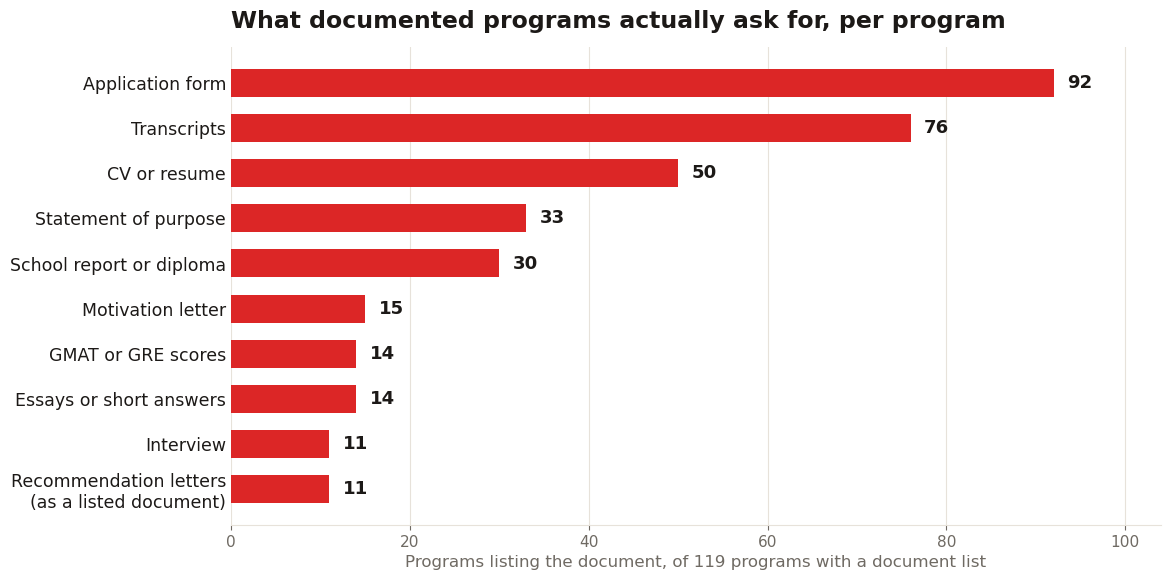
The application form itself leads, at 92 of 119 programs. Obvious, until you notice the form is rarely just a form: supplements, portal accounts and program specific questions ride along with it, which is why it eats more hours than any essay.
Transcripts come second, at 76 programs. Not a copy on your phone. Programs ask for official, attested or portal uploaded transcripts, and the format differs by school, which the transcript requirements in the data spell out program by program.
A CV or resume appears at 50 programs, a statement of purpose at only 33. That surprises people. The statement matters enormously where it is asked, but more programs screen your record and your CV before they ever read a word of prose.
Recommendation letters are listed as a document at just 11 programs, which is misleading. Most programs collect letters through their own portal links instead of the document list; 75 of the 127 programs state a letter count separately, and 32 of those want three. Count letters on their own line in your organizer, never as a footnote.
The standard ten, organized
1. Academic transcripts, attested. Order official copies early; attestation and mailing are the slow part, not the request.
2. Degree certificate or provisional. Final year students use the provisional; everyone else needs the real thing scanned cleanly.
3. Statement of purpose. One base draft, then a version per program. The 33 programs that ask for it weight it heavily.
4. Two to three letters of recommendation. Ask 6 to 8 weeks out. This is the document you do not control, so it goes in the organizer first, not last.
5. CV or resume. One page for most masters applicants, two only when the experience earns it.

6. Test scores. GRE where required, IELTS or TOEFL for English proficiency. Only 14 of the 119 lists name GMAT or GRE outright, so check your programs instead of assuming.
7. Passport copy. Needed earlier than people think, and it must match the name on every other document exactly.
8. Financial documents. Bank statements mostly matter at the visa stage, but some programs ask at application. Keep them in the same folder either way.
9. Application fee payment. A card that works internationally, tested before deadline week, not during it.
10. Portfolio, for design, architecture and arts. Eight programs list a portfolio or audition. For those applicants it is not item ten, it is the application.
The ones everyone forgets
11. A WES or ECE credential evaluation. Takes 4 to 6 weeks; order it first. This is still the single most common way a strong application misses its deadline.
12. A medium of instruction certificate. The document behind most English test waivers, and nobody requests it until the waiver is already in doubt.
13. Syllabus copies of key courses. Some German universities ask for them when judging whether your degree matches the masters.
14. Experience letters on company letterhead. A CV line is your claim; a letterhead letter is the proof, and programs that ask will not accept the claim alone.
Run the list like an organizer, not a pile
Fourteen documents times eight programs is 112 moving parts, each with its own format and its own portal. A spreadsheet copes until the first program swaps a requirement or a recommender goes quiet. This is exactly the job DocCheck was built for: pick your programs and it generates the per program checklist from the same recorded requirements behind the chart above, so the list you work from is the list your programs actually publish. The DocCheck walkthrough shows how the generator builds each checklist, and our organizer apps comparison covers the other tools honestly if you want a second system as backup.
Start with the slow four: credential evaluation, transcripts, recommenders, test dates. Everything else can be finished in a focused week. Those four cannot, and no organizer, ours included, can compress a six week evaluation into six days.
Sources: Common App