
College application deadlines for fall 2027 are not one date, and they are not really a calendar. They are 199 separate deadlines spread across the programs students actually apply to. We know, because we counted them. This page is built from the 127 fully documented programs in our directory of 3,305: every deadline those programs publish, sorted by month and by type. The pattern that emerges is more useful than any single date. Almost everything that matters happens between October and January, and the deadline types students argue about most, early action, priority, regular, are not distributed the way most guides claim.
Key takeaways
- Of the 199 deadlines in the 127 programs, 115 fall between October 2026 and January 2027. January alone carries 34, the heaviest month in the set.
- Only 12 of the 127 programs run a true priority deadline. For most applicants the real choice is early versus regular, not priority versus final.
- 29 of the 127 programs publish more than one deadline, so a single program can ask you to track two or three dates, not one.
When are college applications due?
Most applications for fall 2027 entry opened in the summer of 2026, and the deadlines arrive in waves. Whatever wave you aim for, the components are the same, and our program data shows how consistent they are: an application form, transcripts, and recommendation letters. Of the 75 programs in the set that state a letter count, 32 ask for three letters, 24 ask for two, and 19 ask for one. Essays, portfolios and test scores appear where the program requires them, up to eight required documents on the most demanding programs.
The four main windows, as they actually appear in the data:
- Early action and early decision: 15 deadlines, and every one of them falls between October 15 and November 15, 2026.
- Priority: 15 deadlines at 12 programs, running from August 1, 2026 to March 1, 2027.
- Regular and final: 65 deadlines, the largest family, from November 15, 2026 to July 15, 2027.
- Rolling: 13 deadlines, from August 15, 2026 to July 26, 2027, because rolling programs still publish recommended dates.
The remaining 79 deadlines belong to spring intakes, semester-based intakes outside the US pattern, and split deadlines for EU and non-EU applicants. If you are applying internationally, your program may live in that group instead, which is one more reason a single generic deadline list will mislead you.
College application deadlines for fall 2027, month by month
Here is the full count from the 127 programs. Read it as a workload map: these are the months where your applications, and everyone else's, come due.
- August 2026: 4 deadlines
- September 2026: 9 deadlines
- October 2026: 23 deadlines
- November 2026: 28 deadlines
- December 2026: 30 deadlines
- January 2027: 34 deadlines
- February 2027: 9 deadlines
- March 2027: 16 deadlines
- April 2027: 12 deadlines
- May 2027: 15 deadlines
- June 2027: 6 deadlines
- July 2027: 9 deadlines
- September 2027: 4 deadlines
Two things stand out. First, the peak is later than the advice columns suggest: December and January together carry 64 deadlines, more than October and November combined. Second, the tail is long. Forty deadlines land in March or later, which is why rolling and late-cycle programs can rescue a plan that missed the winter wave, and why a spring search for options is not hopeless.
Early action deadlines
Early action means applying in the fall wave and hearing back around December or January, with no obligation to enroll. In our set, early action and its restrictive variant sit inside a tight band: the early family as a whole, 15 deadlines, runs from October 15 to November 15, 2026. There is no such thing as a casual early application. The essay, the letters and the transcript all have to be ready roughly two months before the regular wave.
Early action suits an application that is already strong by October. It does not suit one that needs the fall semester's grades or another test sitting to look its best, because the file is read as it stands in November.
Early decision deadlines
Early decision shares the early calendar and adds a binding commitment: if the school admits you, you enroll, pay the deposit and withdraw your other applications. Some programs in the data run two early decision rounds, an ED I in the November band and an ED II in the regular season, which gives a rejected or deferred ED I applicant a second binding chance in January.
The caution is financial. You commit before you can compare aid offers, so early decision only makes sense when the school is a clear first choice and the funds works on the school's own net price estimate, not on hope.
Priority deadlines
A priority deadline is an earlier date that buys earlier consideration, and often first access to scholarships or funding pools, without a binding commitment. It is also rarer than the name suggests. Only 12 of our 127 programs publish one, with 15 priority deadlines between them, and the dates wander: the earliest is August 1, 2026, the latest March 1, 2027. There is no common priority day to circle.
Because the gap between a priority date and the same program's final date is where applicants lose funds and places, we wrote a separate breakdown of priority deadline vs final deadline and what actually changes between the two. The short version: meet the priority date when the program offers one, and treat the final date as a fallback, not a plan.
Regular decision and final deadlines
Regular decision is where most applications land, and in the data it is the widest family by far: 65 deadlines. The core cluster is December and January, which matches the January deadlines most seniors plan around, but the family keeps going long after the famous dates pass, out to a final entry on July 15, 2027. Programs with department-set deadlines make up much of that tail, especially at graduate level, where each department inside a university can set its own date.
That spread is the practical lesson of this page. The regular decision deadline for your program is a specific date in a specific department's listing, not a national day in January. Two programs at the same university can close a month apart.
Rolling admissions deadlines
Rolling programs read applications as they arrive and answer within weeks, until the class fills. Even so, 13 of the deadlines in our set belong to rolling programs, because rolling does not mean dateless: programs publish recommended dates, priority points inside the rolling cycle, and hard stops when a cohort is full. Those rolling dates run from August 15, 2026 to July 26, 2027, the longest span of any family.
Applying early inside a rolling cycle is the closest thing admissions has to a advantage. The same file is read against a smaller pile, with more seats and more aid still unclaimed.
Rounds, UCAS and international intakes
Three smaller families complete the map. MBA and business programs run numbered rounds: 8 round deadlines in the set, from September 16, 2026 to April 15, 2027, and the round you choose changes both your chances and your scholarship pool. UK applications run through UCAS: 4 deadlines, from the October 15, 2026 early date for Oxford, Cambridge and medicine to the January 29, 2027 standard date. And 46 deadlines in the set belong to spring intakes, semester intakes and EU versus non-EU splits, the calendars that govern most non-US applications.
None of these appear in a typical deadline roundup, and together they are nearly half the deadlines real programs publish. A list built only from famous American colleges describes a minority of the actual landscape.
Which deadline should you aim for?
Aim for the earliest deadline your application is genuinely ready for, and no earlier. A finished, coherent file at the regular deadline beats a rushed one at the early deadline in almost every admissions office. Work backwards from readiness: if your essays and letters can be strong by mid-October, the early wave buys you an answer by December and a calmer spring. If they cannot, the regular wave is not a consolation prize. It is where most of the deadlines, and most of the admits, actually are.
Then check the specific dates, because the families above are patterns, not promises. Your program's own listing is the only date that counts, and programs move dates between cycles.
Turn the dates into your checklist
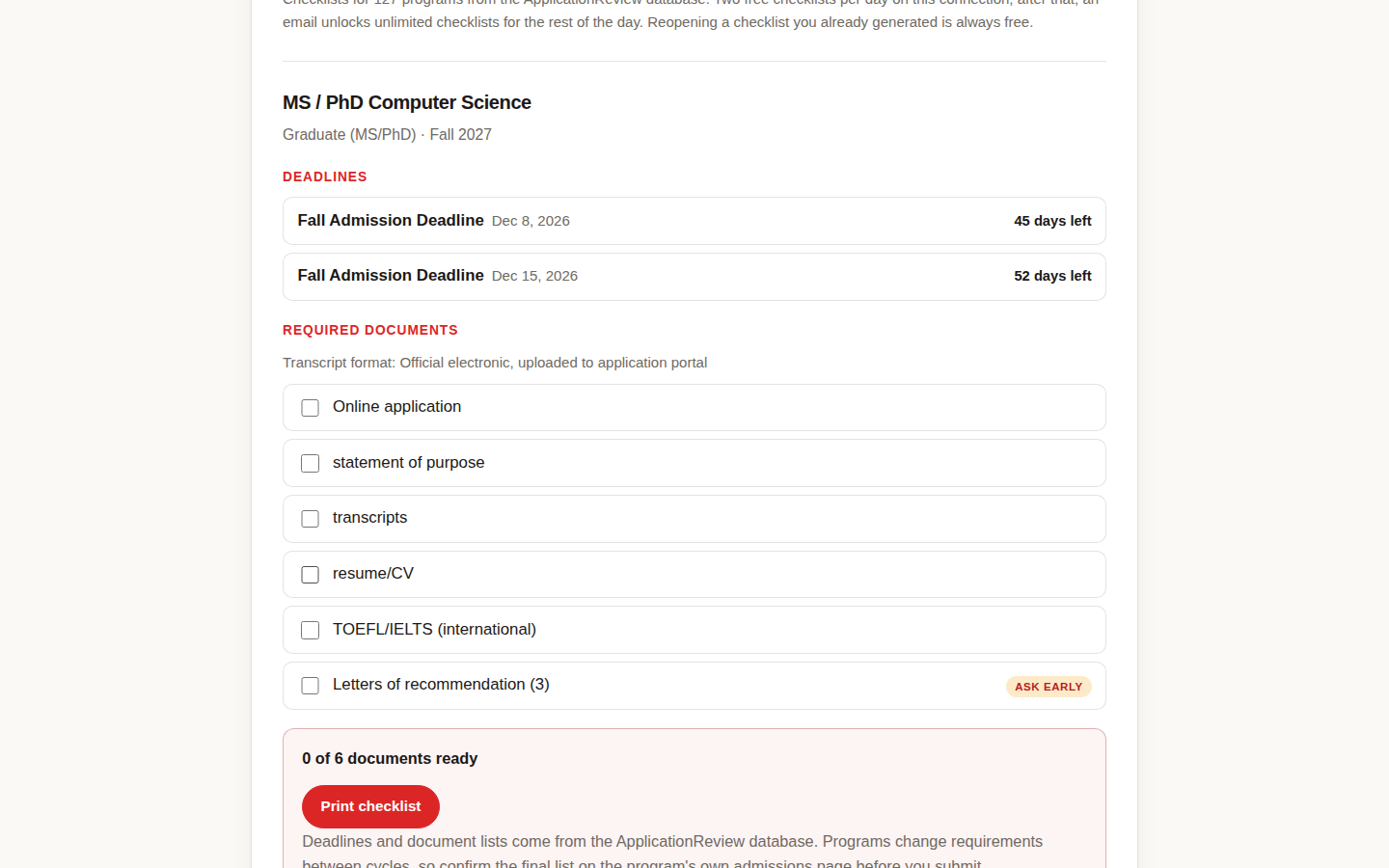
A deadline you have not converted into a task list is just a worry with a date attached. TheDocCheck generator builds the checklist for a specific program: its deadlines in order, the documents it requires, the letters it asks for, ready to work through item by item. Our explainer shows how DocCheck works, and this follow-up covers seven ways to use it before the fall 2027 deadlines arrive.
Start with the program whose date is soonest, generate its checklist, and put every other program's dates next to it. The month-by-month counts above say the winter will be busy. The checklist is how it stays busy instead of chaotic.