
A college admissions timeline makes more sense spread across four years than compressed into one. Freshman year builds the foundation: grades, course choices and activities. Sophomore year adds testing and early research. Junior year is the heavy year, when tests, the college list and the first essays all land at once. Senior year is execution: applications, aid forms and decisions. Starting in 9th grade is not about anxiety or advantage hunting. It is about room: the same work, spread over four years, never has to happen all in one winter. This page walks the year-by-year college application timeline stage by stage, with the milestones that matter in each.
Quick takeaways
- The timeline breaks into four stages: 9th grade for foundations, 10th grade for testing and first research, 11th grade for the heavy lifting, and 12th grade for applications and decisions, with financial planning running underneath all four.
- Students typically take the PSAT in 10th grade as practice and again in 11th, when the same sitting also qualifies them for National Merit recognition.
- The Common Application opens August 1 of senior year, and the FAFSA opens October 1. In our count of 127 documented programs, January carries more deadlines than any other month, which is why junior spring, when essays start, matters so much.
What should freshmen (9th grade) focus on?
Freshman year is for building the base everything else stands on: strong grades and the right courses. Ninth-grade marks count toward the cumulative GPA, and the course choices made this year decide which advanced courses are even reachable later, since many of them have prerequisites. Meet the school counselor early, map a four-year course plan, and treat it as the frame for the next three years.
Outside class, the freshman job is exploration without commitment pressure. Try several activities, clubs, sports, service, and notice which ones still interest you in the spring. An activity found honestly in 9th grade and pursued for four years reads very differently on an application from a crowded list assembled in 11th. Nothing about a college list needs to be decided this year.
When should students take the PSAT?
Most students take the PSAT in 10th grade as a low-stakes rehearsal, then again in 11th grade, when the score also counts for National Merit Scholarship consideration. Schools administer it, usually in October, and in most cases there is no separate registration to manage.
The 10th-grade sitting is diagnostic: it shows where the SAT or ACT work needs to go while there is still a year to do it. The 11th-grade sitting carries the extra stake of National Merit, which some colleges reward with scholarship funds. Neither score is sent to colleges as part of an application, so both are safe places to learn the test.
What should sophomores (10th grade) do differently from freshmen?
Tenth grade layers two new things onto the freshman foundation: test preparation and college research. Keep the grades and the activities going, take the PSAT, and sit a practice SAT or ACT to learn which test suits you better. That choice, made in 10th grade, prevents a wasted year of preparing for the wrong exam.
College research at this stage should stay light and wide. Learn the vocabulary: sizes, settings, program types, costs. Visit a local campus if one is nearby, not to judge it but to start calibrating taste. Students who skip this year of gentle research meet junior year needing to do it under time pressure, alongside everything else junior year already holds.
What should juniors (11th grade) prioritize?
Junior year is the busiest year of the four, and it is not close. Standardized testing, narrowing the college list, securing recommendation letters and starting the application essay all fall inside it. It is also the last full year of grades most colleges will see before deciding, which gives its coursework an outsized weight.
Testing and coursework
Take the PSAT in the fall for National Merit, then sit the SAT or ACT in the spring, leaving the fall of senior year for one retake if the score needs it. Register early; spring test dates fill. Keep course rigor honest: a strong grade in a hard course is the single most persuasive line on the transcript, and junior year is where colleges look hardest.
College list and essays
By spring, a working list should exist: reach, match and likely schools, built from the research started in 10th grade, with visits over spring break or summer where geography and budget allow. Start the main essay before senior year begins. The essay is the one major component that can be finished entirely in the summer, and moving it out of the fall is the highest-value scheduling decision in the whole timeline.
What should seniors (12th grade) expect?
Senior year is execution against dates. The tasks are known; the discipline is meeting them in order. The milestones that structure the year:
- Common App opens: August 1
- FAFSA opens: October 1
- Early action and early decision deadlines: around November 1; in our 127-program set, every early deadline falls between October 15 and November 15
- Regular decision deadlines: commonly January 1 to 15
- Decision notifications: late March to early April
- Enrollment deposit deadline: May 1, National Decision Day
Secure recommendation letters in the early fall, because teachers and professors are writing for many students at once and the September requests get the best letters. Our senior-year timeline expands this year month by month, and the deadlines underneath it are counted in our fall 2027 deadlines guide.
When should you start planning for financial aid?
Earlier than feels necessary. The FAFSA itself is a senior-year task, filed from October 1, but the strategy underneath it, savings, asset positioning, and knowing which colleges meet need and which do not, works on a multi-year clock. Families who first think about cost in senior fall discover that the decisions with real leverage were the ones available in 9th and 10th grade.
The practical minimum: know, by junior year, roughly what your family can pay per year, and let that number shape the college list before applications go out. A list built without a budget produces April surprises that no amount of senior-year effort can fix.
Is it too late to start planning in junior or senior year?
No. Starting late does not change the task list; it compresses it. A junior-year start still allows testing, list building and a summer essay, in that order of priority. A senior-year start is harder but workable for the regular decision wave, provided the list is realistic and the essays begin immediately. Our November plan for January deadlines was written for exactly that compressed case.
What a late start cannot do is recover the slow assets: four years of one activity, a transcript built course by course. It does not need to. Colleges read late bloomers every cycle. The plan just has to be honest about which evidence exists and build the application around that, in the right order, against the real dates.
Frequently asked questions
What grade should you start planning for college?
Ninth grade, lightly: course planning, grades and activities. The planning gets heavier each year, with testing in 10th and 11th grade and applications in 12th. A 9th-grade start is recommended not because applications begin then, but because the transcript and record that applications report on do.
How many times should a student take the SAT or ACT?
Most students take their chosen test at least twice: once in the spring of junior year and, if the score can improve, again in the fall of senior year. A PSAT in 10th or 11th grade provides the practice and the baseline. More than three sittings rarely change the outcome enough to justify the time.
When is the best time to visit colleges?
Spring break and the summer of junior year are the standard windows: late enough that the student has real preferences, early enough that the list can still change before senior fall. A second round of visits in April of senior year, to admitted schools only, serves a different purpose: choosing, not searching.
When does the FAFSA open each year?
October 1, for the following academic year. File it in the fall of senior year rather than near the federal deadline, because some state and college aid is awarded first come, first served, and many colleges set their own earlier priority dates for aid.
Turn the four years into one checklist
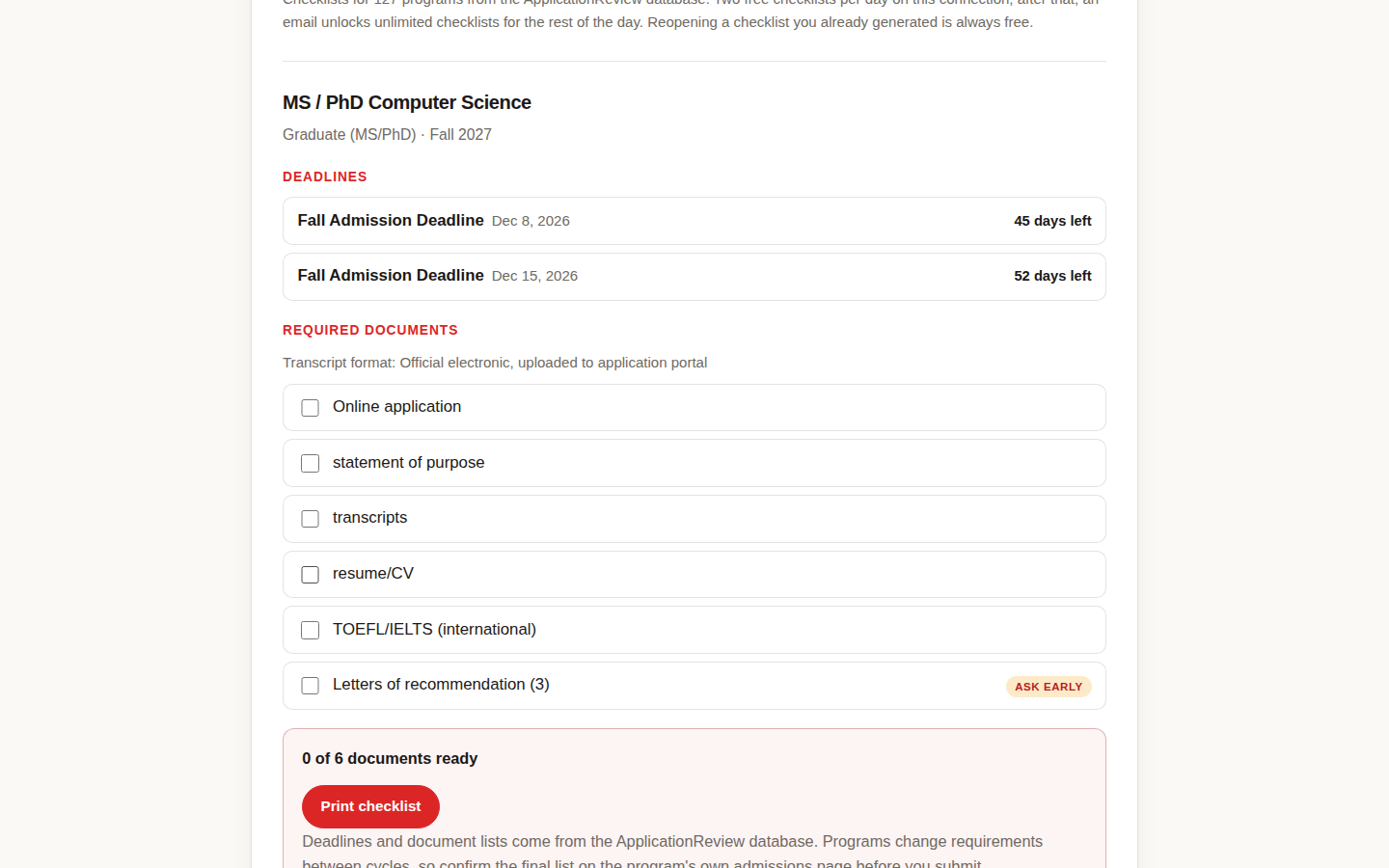
However early the planning starts, senior year ends the same way: a list of programs, each with its own deadlines and document requirements. TheDocCheck generator builds that checklist per program, and this guide shows seven ways to use it before the deadlines arrive. Families managing the timeline for the first time do not need more advice. They need the four years written down in order, and this page is that order.